

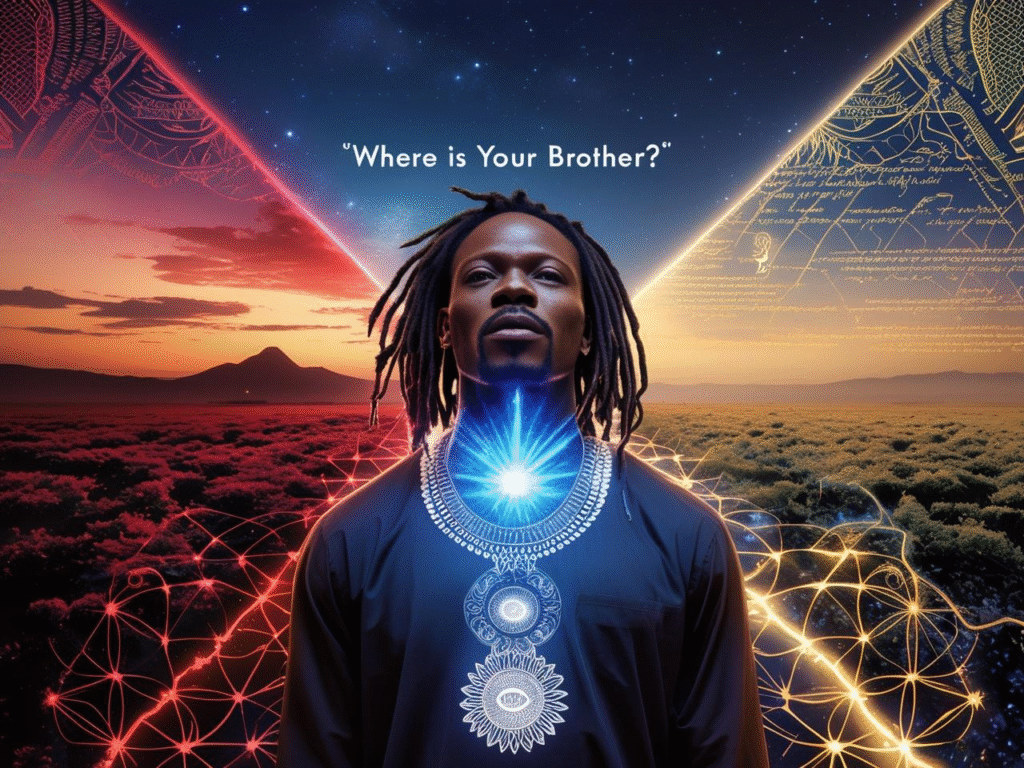
Genesis 4:9, Where is Your Brother?
🌟 The Throat Chakra
📜 Introduction
In the beginning, the journey of the soul begins with a spark—a divine invitation to awaken and create. In Genesis 4:9, God asks Cain, “Where is your brother Abel?” and Cain replies, “I do not know. Am I my brother’s keeper?”
This passage is not just a historical event—it is a mirror of the soul. It reflects Adam’s inner fragmentation after the fall from Eden. Cain and Abel are not external sons but inner creations: personas formed within Adam’s psyche. Cain is the part of Adam born from fear, shame, and self-protection. Abel is the radiant part of Adam that still remembers divine love. This is not a story of sibling rivalry. It is a story of spiritual memory and amnesia—of how our lower self can silence the voice of the higher one when we are not ready to fully embody love.
Every word in this scripture mirrors our own sacred journey: the struggle between fear and love, the voice of denial and the whisper of truth. The divine question “Where is your brother?” is also “Where is the part of you that remembers Me?”
May this reflection guide you back to the Source of your being, as you awaken the light within and walk the eternal path of Adam’s transformation.
📖 Scripture Passage
Genesis 4:9
Then the Lord said to Cain, “Where is your brother Abel?”
“I don’t know,” he replied. “Am I my brother’s keeper?”
🕊️ Allegory & Metaphysical Interpretation
Cain and Abel are not merely siblings—they are soul fragments of Adam himself. After the exile from Eden, Adam’s consciousness fractures. In his pain, he creates Cain, a personality built from fear, survival instinct, and defensiveness. Cain is the self that emerges when we feel cast out of love—when we believe we must protect ourselves from further abandonment.
But Adam also remembers. In a brief but sincere moment of inner clarity, he creates Abel—a gentle, devoted aspect of self that turns back toward the Most High. Abel represents Adam’s return to remembrance, humility, and divine alignment.
Yet the tragedy is that Adam, still carrying the energetic imprint of exile, cannot yet sustain the vibration of love. Cain—rooted in fear—rises and overcomes Abel. The part of Adam that could not bear to remain vulnerable kills the part that sought to love. And so the inner war begins: a soul divided against itself.
When God asks, “Where is your brother?”, He is not interrogating a criminal—He is inviting the soul into awareness. He is asking: Where is the higher self you silenced? The part that remembered Me? The divine voice is a mirror—not of shame, but of truth. It calls us to accountability, not as punishment, but as an invitation to wholeness.
Cain’s response, “Am I my brother’s keeper?”, is the voice of a blocked Throat Chakra—one who cannot speak truth, take responsibility, or honor the soul’s unity. It is the voice of disconnection. But even this is not the end—because the question remains. And every time we hear it, we are given another chance to answer differently.
🔄✨ Reincarnation & the Soul Journey of Adam
🌸 A Core Truth of This Decode Series
📖 Each Book of the Bible is not just a continuation of a story—it is a new incarnation of Adam, the soul in form. In every life, Adam awakens through desire, creates personas through Eve, and walks the long spiral home to Divine Union.
🌺 Eve is the spiritual chooser—the one who offers Adam the fractal personas he desires. Her love is unconditional. She does not control, only responds, providing what the soul asks for—even when that path leads through illusion.
🌐 This cycle mirrors the sacred Flower of Life:
- Each petal = a persona within a lifetime
- Each circle = a full reincarnated life
- Every intersection = a karmic lesson, a sacred turning, a point of remembrance
📚 Genesis is the spark.
🔥 Exodus is the awakening.
🕯️ Leviticus is the ritual.
🌲 Numbers is the wandering.
🏞️ Deuteronomy is the return.
✨ Wherever you are in this series, remember:
You are Adam. You are Eve. You are the soul remembering itself through every form.
This is not just scripture—it is your journey.
🔮 The Emerald Tablet Insight
“As above, so below. As within, so without. As the universe, so the soul.”
The ancient wisdom of the Emerald Tablet reminds us that the inner cosmos is the true battleground of creation. In Genesis 4:9, we are not witnessing a crime scene—we are being shown the alchemical consequences of misalignment within the soul. The Tablet teaches that all creation begins within, and Cain and Abel are evidence of this truth: two frequencies born from the same Source, each reflecting the inner polarity of man.
Cain represents the volatile prima materia—unrefined, unstable, driven by fear and shadow. Abel, by contrast, is the purified essence, the subtle body of light aligned with the divine breath. When Cain rises against Abel, we are witnessing not the death of a man, but the silencing of divine memory. In alchemical language, this is the soul abandoning its inner gold and collapsing back into base matter.
But alchemy is never about perfection—it is about transformation.
The voice that asks, “Where is your brother?” is the same voice that stirs the prima materia into motion. It is the first distillation. A sacred question designed not to condemn, but to separate the false from the true, the impure from the pure. Judgment, in this context, is not damnation—it is discernment, the essential act that begins the alchemical journey.
This moment aligns with the Throat Chakra, the energetic center of truth, accountability, and divine communication. When blocked, it manifests as denial, evasion, and refusal to speak our soul’s knowing. When open, it becomes the conduit for divine remembrance—the vessel through which the lost parts of the self are named, healed, and reintegrated.
Cain’s denial is a refusal to transmute. But the divine question remains—a call echoing from within the crucible of the heart. It invites us, even now, to speak truth, to name the sacred, to remember the brother within—the part of ourselves we abandoned in fear.
💎 Emerald Teaching:
Transformation begins with the willingness to name what was lost.
The higher self can only return when the voice is ready to speak its truth.
Each time we are asked, “Where is your brother?”, we are being offered a chance to answer as the alchemist:
“He is within me still. And I am bringing him home.”
🌟 Tarot Guidance
🌟 Why Use Tarot to Help Explain the Bible?
Tarot and the Bible both speak the language of the soul—a symbolic language that transcends time, culture, and religious tradition. When we read the Bible as a mystical or allegorical text, Tarot becomes a powerful companion tool that can help us:
Two archetypes mirror this passage:
- The Five of Swords: inner conflict and moral loss. A hollow victory that reveals where the ego has won at the cost of peace.
- Judgement: the divine call to awaken. This is God’s voice in the story—calling Cain (and us) to step beyond denial into reconciliation.
This is the moment the soul is asked to rise—to admit the truth and choose again.
🌟 A Course in Miracles Reflection
“You are your brother’s keeper. You are your brother. You are not separate.”
This passage aligns with the core teaching of the Course: there is no separation. To harm another, even in thought, is to harm yourself. To deny your brother is to deny the God within.
- Key Lesson: The ego always speaks first. The Holy Spirit is the still small voice that waits behind it.
- Reflection: Cain’s voice is loud and defensive. But the Divine question still echoes, waiting for the soul to hear it with open ears.
🎶 Song Intro: Keeper of My Brother
In the beginning, the journey of the soul begins with a spark—a divine invitation to awaken and create. Genesis 4:9 is not simply a record of Cain and Abel’s exchange—it is the soul itself, questioned by the Divine. “Where is your brother?” is not about another man in the field—it is about the forgotten part of ourselves, the memory of love we silenced when fear took control.
Cain and Abel are not external figures—they are inner voices. Cain is the guarded self, born of fear and exile; Abel is the radiant self, born of surrender and remembrance. When the Divine asks Cain to account for Abel, the question reaches across all lifetimes and all incarnations: Where is the higher self within you? Where is the love you buried?
Keeper of My Brother, by AfroWave AI (Alchemist Iris), carries this question into sound. Set to the healing frequency of 741 Hz, the Throat Chakra, the song becomes a mirror and a medicine—calling us to speak truth, to remember the light we abandoned, and to return to wholeness. This is more than rhythm and lyric—it is the sound of accountability, a path of remembrance through music.
✨ Closing Blessing
May your voice remember its sacred origin.
May your silence be healed, and your soul be heard.
May the part of you that sought the Most High return home through your own words.
You are your brother. You are your voice. You are the one you’ve been waiting for.
So may it be.
— Alchemist Iris


Choosing is our own responsibility. We can choose to be like Cain or to be like Abel. But we can not be both. Being like Cain leads to a path of self-destruction. But being like Abel is the path of life. This way leads to the sacrifice of the lamb, the only sacrifice accepted for the purging of our sins.
Thank you, Abel—beautifully said.
I agree: choosing is ours. In my work I often explore Cain and Abel both as real figures and as mirrors of our inner life. On the literal path, “the Lamb” points us to Christ’s once-for-all offering and the way of life that flows from it. On the inner path, that same Lamb looks like the surrender of fear, pride, and self-justification—the parts of us that “murder” love—so the higher, loving voice can lead.
Whether we read the story outwardly or inwardly, the invitation feels the same to me: let love govern. Let the Lamb lead. And let “Where is your brother?” call us back—daily—to take responsibility for the life we’re carrying within and the care we owe one another.
A simple practice I use:
Pause when I feel the Cain-impulse (defensiveness, envy, hardening).
Breathe and ask: “Where is my brother? Where is the Lamb?”
Choose one concrete act of keeping—an apology, a kindness, a truth spoken in love.
Thank you for naming the choice so clearly. It sharpens the path.
This really helps once you set your mind to it as well as being open to it. That line hit me right in the chest: “Where is the higher self within you? Where is the love you buried?” We tend to bury parts of ourselves that feel too vulnerable or risky to keep alive. Reading it like that makes me realize how many times I’ve silenced my own “Abel” voice because it felt safer to operate from fear and defensiveness.
The idea that God’s question isn’t about punishment but about calling us back to what we’ve abandoned within ourselves… that changes everything. It makes me want to dig up all those buried pieces of love I’ve been too scared to let breathe again.
Linda, thank you for sharing so openly. I’m touched by how deeply that line resonated with you. What you said about silencing the “Abel” voice out of fear or self-protection is something many of us can relate to. We’ve all had those moments where love felt too tender to risk showing, so we buried it under layers of defense.
I love how you framed God’s question as not punishment but invitation. That really is the heart of it—divine love is always asking us to remember, to uncover, to breathe life back into the pieces of ourselves we thought were safer left hidden. The courage you’re showing in even naming that desire to “dig up those buried pieces of love” is already part of the healing.
May you find that every time you choose to let one of those buried pieces breathe again, it not only reconnects you with your higher self but also ripples out as healing to others around you. That’s the beauty of this inner work—it never stays just within us, it becomes a blessing that multiplies.
With love and light,
Iris
I appreciate the depth here, but I see Genesis 4:9 a little differently. Cain and Abel weren’t just fragments of Adam’s soul, they were real people, and the tragedy of Cain’s sin shows us the reality of what happens when we harden our hearts against God. The Bible is clear that sin entered through Adam and passed to all, and Cain’s refusal to take responsibility for his brother reminds us why we need Christ. Jesus later affirms that yes, we are our brother’s keeper, called to love one another as He loved us. While I respect the symbolic take, I find hope in the straightforward truth of Scripture, that God doesn’t leave us divided, but sent His Son to reconcile us back to Himself.
Blessings,
Jason (Founder of Prepared and Redeemed)
Jason, thank you for sharing this. I’m with you that Cain and Abel were real people and that their story names the danger of a hardened heart—and our hope in Christ. I also read the text devotionally, as a mirror of the inner life. In that sense, I hold a both/and: whether these are sides of our own consciousness or two separate people, both are real. The inner lens doesn’t erase the historical one; it invites me to live it more faithfully.
I’d add this: the inner conflict is something we all recognize, while most of us will never face a literal “brother seeking our life.” Reading Scripture in a way that meets people where they are—at the level of conscience, relationships, and daily choices—helps the Word become a lamp for our feet. That accessibility is a blessing.
Luke 17:20–21 (KJV): “The kingdom of God cometh not with observation: … behold, the kingdom of God is within you.” There’s a serious reason for this scripture.
Where we meet beautifully is here: Christ enables what the command requires. He reconciles us to God and empowers us to keep one another in love (John 13:34–35; 2 Cor 5:18). Of course, if the brother killing brother deeply resonates with you and your life experience, I truly understand. Grateful for your thoughtful contribution and for your work with Prepared and Redeemed. Blessings!
— Iris
This was such a powerful interpretation of Genesis 4:9—I’d never thought of Cain and Abel as inner aspects of the self before. The way you connected it to fear, love, and even the Throat Chakra really deepened the meaning for me. Do you think the ‘Where is your brother?’ question is something we’re each being asked daily in small ways, through our choices? And how do you see practices like meditation or prayer helping us reconnect with that silenced higher self?”
Thank you so much, Letsret — I’m grateful this landed for you.
Yes, I do believe “Where is your brother?” is a daily question. It meets us in small choices: how we speak to ourselves, how we respond when we feel threatened, whether we choose fear’s urgency (Cain) or love’s quiet trust (Abel). In that sense, the verse isn’t only historical; it’s a mirror. God’s voice comes as a gentle inquiry that brings the split within us into the light, especially at the Throat Chakra where truth, compassion, and alignment meet.
For me, meditation and prayer are how I let Abel’s voice rise again:
A simple micro-ritual
Pause & Breathe: Inhale through the nose for a count of 4, hold 4, exhale 6. I place one hand on my throat and one on my heart to bridge voice and love.
Name What’s Here: “In this moment, I notice ___ (fear, anger, shame). I allow it to be seen without judgment.”
Prayer of Reunion: “Holy One, align my voice with love. Let what I speak restore the bond within me and with my brother/sister in the world.”
Choice & Blessing: I choose one small act of repair (a truthful text, an apology, a boundary said kindly) and whisper, “May my words be a bridge.”
On days when the “Cain” energy feels loud, I’ll add a few rounds of gentle tapping at the collarbone or along the sternum while repeating: “Even when I feel reactive, I choose a higher response. My voice serves love.” The body settles, the throat softens, and I can hear that quieter guidance again.
A journaling prompt you might like:
“Where is my brother within me today, and how can my voice bring us back together?”
Answer it in two columns—Fear speaks / Love responds. Then let your next small choice follow Love’s reply.
In this way, the question becomes a compass. Each time I answer it with presence, I feel the inner siblings reconciling—and my words begin to heal both my world within and the world I touch.
I’ve read several of your posts, and I must say, I really appreciate the way you invite us to see familiar scripture from a fresh and transformative perspective. Your reflection on Cain and Abel as representations of inner fragments of Adam’s soul really resonated with me. It made me stop and think about how often my own “Cain” voice, full of fear and defensiveness, overshadows that gentler “Abel” voice that just wants to remind me of love.
I found your connection between Genesis 4:9, the Throat Chakra, and the process of alchemy to be incredibly powerful. It shifts my understanding of God’s question, “Where is your brother?” from one of judgment to an invitation for awakening. That fresh perspective feels liberating, almost like stepping through an open door back to a sense of wholeness.
Thank you for intertwining scripture, mysticism, and meaningful self-reflection in your writing. Each post feels like both a mirror and a map for me. This particular piece especially inspires me to tune in and listen for that quieter voice within, encouraging me to respond to God’s question in a way that’s different from how Cain did.
Hi Alyssa,
Thank you so much for sharing this reflection — your words really touched me. I love how you described recognizing your own “Cain” and “Abel” voices. That awareness alone is such a powerful step on the path of integration and healing.
When we see Cain and Abel as facets of Adam’s soul — and by extension, of our own — the story stops being about judgment and becomes a mirror. God’s question, “Where is your brother?” calls us inward, inviting us to notice where we’ve abandoned love within ourselves. It’s less about condemnation and more about realignment, as you so beautifully sensed.
I’m especially glad the connection to the Throat Chakra and alchemy resonated with you. The “quieter voice” within — that gentle Abel — speaks from wholeness, but it takes intention to pause, breathe, and listen. In doing so, we transmute fear into compassion, allowing God’s question to awaken rather than shame us.
Thank you for walking this path of self-reflection and sharing your heart here. Your journey of tuning in and responding differently than Cain is exactly the work of alchemy — turning inner division into sacred union. ✨
With gratitude,
Iris